Learn Hugging Face Bootcamp review
Open-source ML with transformers, diffusers and Gradio.
The quick verdict
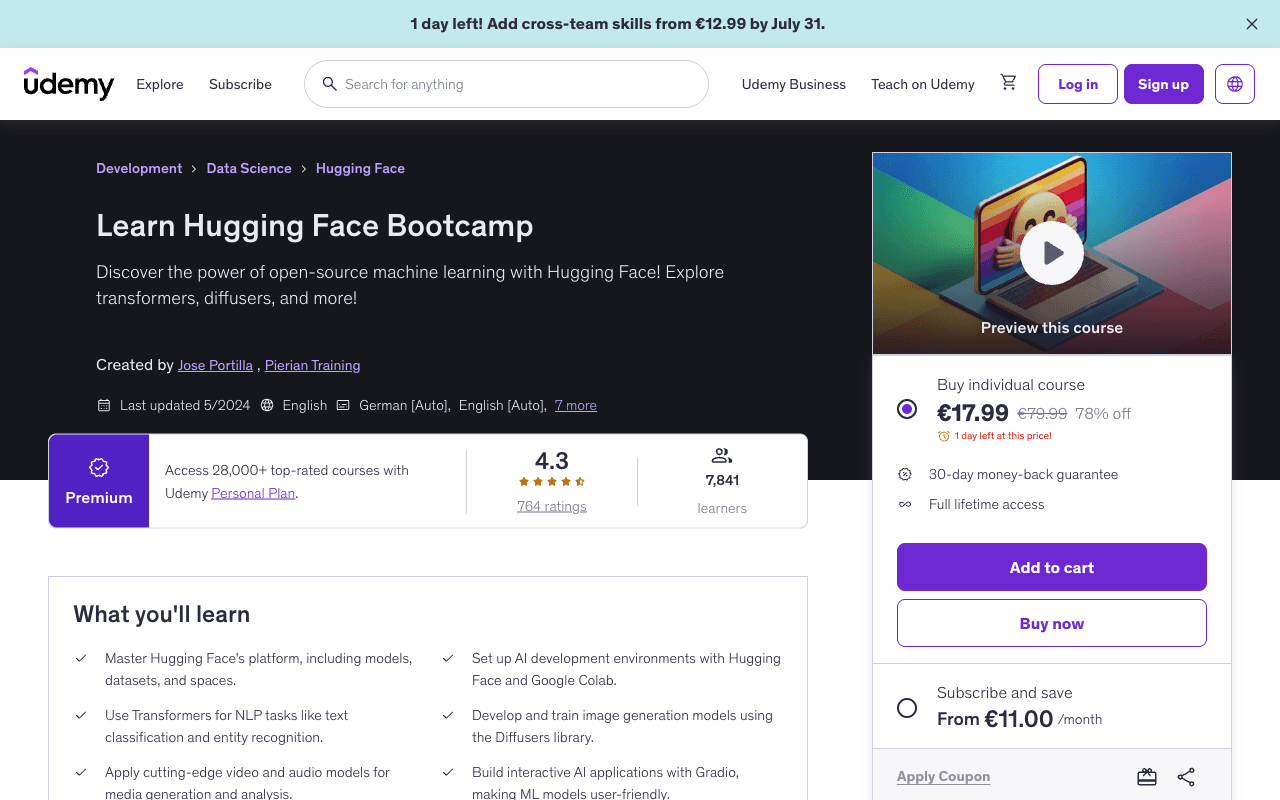
Jose Portilla's 9.5-hour tour of the Hugging Face ecosystem: the Transformers library for NLP, Diffusers for image generation, video and audio models, and Gradio for putting a usable interface on a model. The one course on this list that goes below the API layer into open-source models you run yourself. Rated 4.3 from 764 ratings, but last updated May 2024, and it genuinely requires Python, PyTorch and CUDA. Best for python developers moving from ai apis to open-source models.
What stood out
- Covers the whole Hugging Face stack, not just text: transformers, diffusers, video, audio and Gradio
- Teaches open-source models you host yourself rather than a single vendor's API
- Taught by a long-running, high-volume Udemy data science instructor
- Tight at 9.5 hours across 49 lectures, so it is finishable
Worth knowing
- Last updated May 2024, which is old for this field, so expect drift in library APIs and model names
- Genuinely technical prerequisites: Python, pip, PyTorch, CUDA and Jupyter are all assumed
- Small review base (764 ratings) next to the six-figure counts on the big AI courses
- Light on LLM fine-tuning depth compared with a dedicated LLM engineering track
Typically List ~$80+ · often ~$20 on sale
Affiliate link. AcademyGems may earn a commission, at no extra cost to you, and it never sways the verdict.
What it is
Learn Hugging Face Bootcamp is Jose Portilla's hands-on course on the Hugging Face ecosystem, the open-source hub where most public ML models actually live. It runs 9.5 hours across 8 sections and 49 lectures, and holds a 4.3 rating from 764 ratings. On AcademyGems's Udemy courses list it fills a specific gap: every other pick teaches you to use AI through somebody's API, and this one teaches you to run the models yourself.
Who teaches it
Jose Portilla is Head of Data Science at Pierian Training and one of the longest-running, highest-volume data science instructors on Udemy, with a large catalogue spanning Python, machine learning and data analysis. The teaching style is the one his Python courses are known for: notebook-driven, build-as-you-go, light on theory.
What is inside
The course is organised by model type rather than by tool, which is what makes it useful:
- Introduction to Hugging Face: models, datasets and spaces, plus environment setup
- NLP with the Transformers library: text classification, entity recognition and related tasks
- Image generation with the Diffusers library
- Video models
- Audio models, the section most competing courses skip entirely
- Building machine learning GUIs with Gradio, so a model becomes something a person can actually use
- An appendix on Git
The requirements are stated plainly on the course page and are worth taking seriously: Python and pip, PyTorch and CUDA, and Jupyter notebooks. This is not a no-code course.
How it compares
- vs AI Engineer Core Track: Ed Donner's course is five times longer and aimed at shipping LLM products, with RAG, QLoRA and agents. This one is narrower and lower-level, focused on the open-source model ecosystem itself, including image, video and audio. If you want to build an AI product, take the Core Track; if you want to understand and run open models, take this.
- vs ChatGPT & Generative AI: The Complete Guide: Academind's course touches running open LLMs locally as one section among many. This is that idea expanded into a full course, across every modality.
- vs Zero To Mastery: ZTM's Machine Learning with Hugging Face Bootcamp covers similar ground for roughly $25/month as part of a subscription. If you only want this one topic, the standalone Udemy purchase is cheaper; if you want the wider catalogue, ZTM wins.
Who it is for
Python developers and data scientists who are comfortable in a notebook and want to move past API calls into open-source models they can host, fine-tune and wrap in an interface. The Gradio section is the practical payoff: it turns a model into something you can hand to someone.
Who should skip it
Non-technical learners should skip it outright. The prerequisites are real, and PyTorch plus CUDA in particular means you need to be comfortable with the ML tooling stack before you start. The bigger caveat is the date: this course was last updated in May 2024. The Hugging Face libraries move quickly, so expect some API drift and dated model choices, and budget time for reading current docs alongside the videos. If you want a course that reflects the state of the field this year, a more recently refreshed pick will serve you better.
Pricing, and the one rule
It was listed around €80 and discounted to roughly €18 when AcademyGems last checked, with regional pricing and near-constant sales, so treat both figures as approximate. The usual Udemy rule applies: never pay list price, and lean on the 30-day refund. The extra rule here, given the 2024 update date, is to check the course page's own "last updated" stamp before buying, because if it has not moved, the drift will only have grown.
First-look verdict
The most technically distinctive course on this list, and the only one that treats image, video and audio models as first-class rather than an afterthought. On sale it is worth it for a Python developer who wants the open-source side of AI. The stale update date is the honest catch: buy it for the concepts and the ecosystem map, expect to patch the specifics yourself.
How to read this review
Best fit
Learn Hugging Face Bootcamp is strongest for python developers moving from ai apis to open-source models. Its best signals are covers the whole hugging face stack, not just text: transformers, diffusers, video, audio and gradio and teaches open-source models you host yourself rather than a single vendor's api. Use that as the real buying test, not the broad promise on the sales page.
Skip or wait if
Be cautious if last updated may 2024, which is old for this field, so expect drift in library apis and model names or genuinely technical prerequisites: python, pip, pytorch, cuda and jupyter are all assumed. For a first-look listing, treat the sources and the live provider page as the final source of truth before paying.
Evidence notes
AcademyGems does not invent ratings. The 4.3 score shown here is attributed to Udemy. Price and access can change quickly, so confirm the live page before buying or subscribing.
Sources
First look: this entry is researched from the sources above and not yet a completed hands-on review. Figures were accurate as of September 2026; prices and member counts change, so confirm on the provider's page before you buy.
Compare Learn Hugging Face Bootcamp against similar picks
AI Engineer Core Track: LLM Engineering, RAG, QLoRA, Agents
Ed Donner's hands-on course building generative-AI products across 20+ models, covering RAG, QLoRA fine-tuning and agents through many real projects. Aimed at developers who want to ship, not just watch.
AI Engineer Agentic Track: The Complete Agent & MCP Course
Ed Donner's 21-hour agentic AI course on Udemy: a six-week program building eight real projects across the OpenAI Agents SDK, CrewAI, LangGraph, AutoGen and MCP, ending in a trading floor run by four agents and six MCP servers. 4.7 from 46,748 ratings and 383,273 students, updated July 2026. The deepest agent curriculum AcademyGems has found on Udemy.
ChatGPT & Generative AI – The Complete Guide
A ~21.5-hour, 350-lecture guide from the well-known Academind team, spanning basic ChatGPT use to building AI agents, RAG, fine-tuning and AI-assisted developer tools like GitHub Copilot and Cursor.
ChatGPT & Midjourney: 23 Ways of Earning Money with AI
A ~7-hour course teaching 23 income strategies using ChatGPT and Midjourney, freelancing on Fiverr/Upwork, selling AI art, publishing eBooks, and running print-on-demand stores. Beginner-oriented with case studies.
Learn Hugging Face Bootcamp: common questions
- Do I need to know Python?
- Yes, and more than Python. The course page lists Python and pip, PyTorch and CUDA, and Jupyter notebooks as requirements. This is a course for people already inside the ML tooling stack, not an on-ramp to it.
- Is the course still current?
- It was last updated in May 2024, which is old for this field. The core concepts (transformers, diffusers, Gradio, the Hugging Face hub) still hold, but expect library API drift and dated model names. Check the 'last updated' date on the course page before buying.
- How long is it?
- Around 9.5 hours of video across 8 sections and 49 lectures, plus one article and a downloadable resource. It is one of the shorter technical courses on this list, which makes it realistically finishable.
- What does it cover beyond text models?
- Quite a lot, and this is its main differentiator. Alongside NLP with the Transformers library, it covers image generation with Diffusers, video models, audio models, and building interfaces with Gradio. Most competing AI courses stop at text.
- How much should I pay?
- Not the list price. It was listed around €80 and discounted to roughly €18 when this website last checked, and Udemy runs near-constant sales. There is a 30-day money-back guarantee.
- Who should skip it?
- Non-technical learners, and anyone who wants to build LLM applications rather than run open-source models. For the former, a broad tour like The Complete AI Guide fits better; for the latter, the AI Engineer Core Track goes far deeper on RAG, fine-tuning and agents.
Typically List ~$80+ · often ~$20 on sale
Affiliate link. AcademyGems may earn a commission, at no extra cost to you, and it never sways the verdict.