Udacity review
Mentor-reviewed AI, data and cloud Nanodegree programs, built with AWS, NVIDIA and Kaggle.
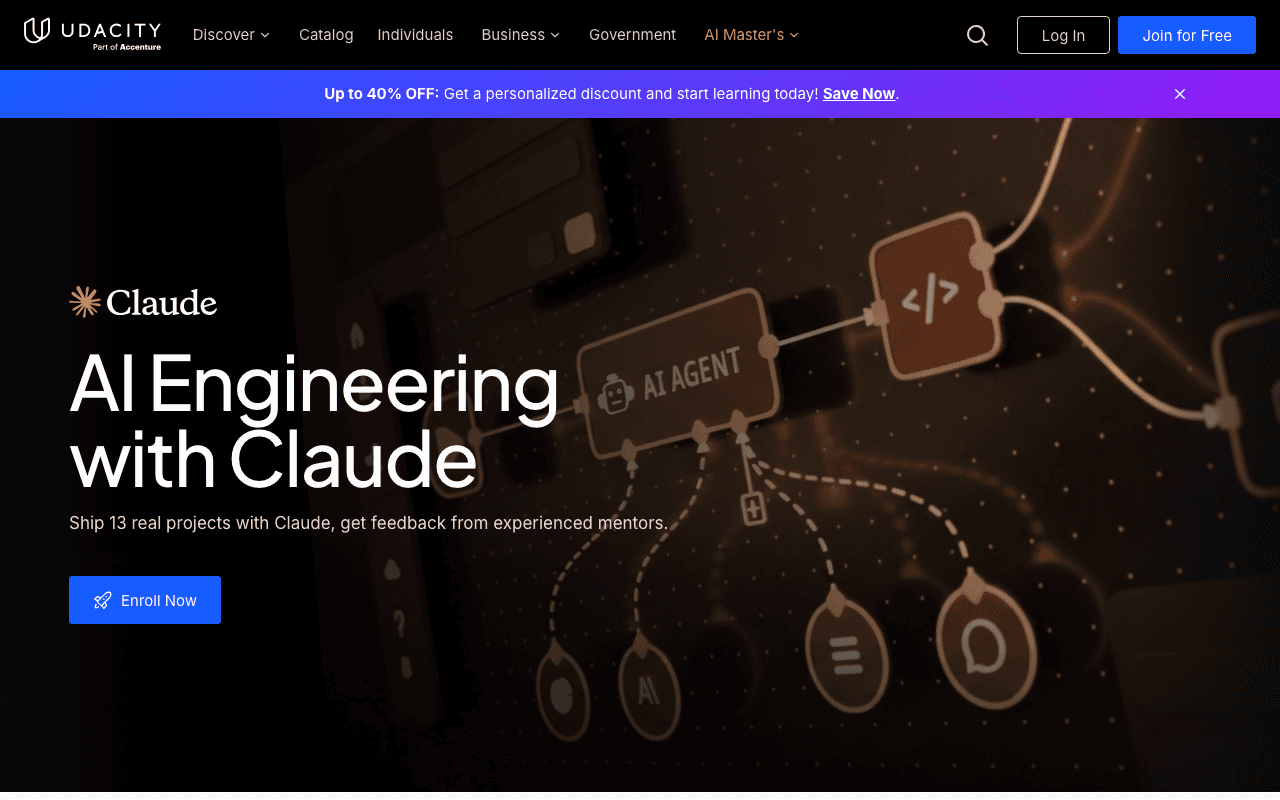
The quick verdict
Udacity is a subscription learning platform built around project-based "Nanodegree" programs in AI, machine learning, data and cloud, with real mentor feedback on your submitted projects rather than auto-graded quizzes. A single subscription unlocks its full catalogue while you stay subscribed; free intro courses exist for a no-cost first look. Best for mentor-reviewed, project-based ai, ml and cloud nanodegrees.
What stood out
- Real human mentors review your submitted projects, not just auto-graded quizzes
- Deep AI/ML/cloud catalogue co-built with AWS, NVIDIA, Kaggle, IBM Watson and Intel
- 4.5/5 on Trustpilot from 3,000+ reviews, with 80% five-star
Worth knowing
- Premium pricing, roughly $249/month versus $59/month for Coursera Plus
- Some reviewers report parts of the course library feel dated
- Project review turnaround runs 3 to 4 days, slower than instant-feedback platforms
Typically ≈$249/mo subscription (4-month bundle ≈$846, ~15% off)
Affiliate link. AcademyGems may earn a commission, at no extra cost to you, and it never sways the verdict.
What it is
Udacity is a subscription learning platform built around "Nanodegree" programs: multi-week, project-based tracks in AI, machine learning, data science and cloud, where you submit real projects and a human mentor reviews and grades them. It began in 2012 when Stanford instructors Sebastian Thrun and Peter Norvig put their Introduction to Artificial Intelligence course online for free and over 160,000 people enrolled, which led Thrun to co-found Udacity that same year. It sits alongside DataCamp and DeepLearning.AI on this website's learning platforms list, rated 4.5 on Trustpilot from 3,361 reviews, a genuine third-party score rather than one AcademyGems assigned itself.
Who teaches it
Udacity's Nanodegrees are co-created with named industry partners rather than a single instructor: AWS, NVIDIA, Kaggle, IBM Watson and Intel all have programs with their branding attached, alongside Udacity's own in-house curriculum team. That partner model is the credibility angle: an AWS Machine Learning Engineer Nanodegree, for instance, is built with AWS's own team, not a generalist course creator guessing at what the exam or job actually requires.
What is inside
The AI-focused catalogue alone covers a real range of depth:
- AI Programming with Python (beginner, Python and neural network basics)
- Introduction to Machine Learning with TensorFlow or with PyTorch
- Deep Learning (CNNs, RNNs, GANs, diffusion models)
- Computer Vision (object detection, facial recognition, image analysis)
- Natural Language Processing (machine translation, summarization, Q&A)
- Deep Reinforcement Learning (policy optimization, Q-learning)
- AWS Machine Learning Engineer Nanodegree
- AI Trading Strategies (backtesting and financial modeling with AI)
Every Nanodegree centers on submitted projects with mentor feedback, plus career coaching and interview prep bundled into the subscription. A handful of free courses (Intro to TensorFlow, Intro to Artificial Intelligence, Intro to Machine Learning) let you sample the teaching style at no cost first.
The pricing detail that costs people money
Udacity sells two ways, and the difference is not the one the page emphasises. Verified on Udacity's own pricing page on 8 September 2026:
- Monthly subscription, unlimited access to a stated 500-plus courses, cancel anytime
- Bundle subscription, four months paid up front at 15% off, which is the option the page highlights
The catch is in the asterisk. The 15% discount applies only to the first four months, after which the plan converts to the standard rate. So the headline saving is a one-off on the first term, not an ongoing lower price, and the bundle's advertised monthly figure is not what you pay from month five.
Prices are shown in your local currency, so the exact figures move with where you are. The structure does not: verify the renewal rate at checkout, not the promotional one.
Who it is for
People who want a structured, deadline-driven AI or data track with actual human feedback on real projects, not just video lectures. The named-partner Nanodegrees (AWS, NVIDIA) are a strong fit if you are targeting a specific certification or job requirement those partners define.
Who should skip it
If your budget tops out around $50 to $60 a month, Coursera Plus or DataCamp cover similar ground for a fraction of the price, just without mentor-graded projects. Reviewers also flag that some course material has not been refreshed as often as the fast-moving AI space demands, so check a Nanodegree's last-updated date before buying. If you want the cheapest possible route into AI skills, start with Udacity's free intro courses before paying for a Nanodegree.
Pricing, and the one rule
Udacity moved to a subscription model: roughly $249 a month for unlimited access to 500+ courses and Nanodegree programs while you stay subscribed, or a 4-month bundle at around $846 (about 15% off the monthly rate). Udacity also runs frequent personalized discount codes of 25% to 75% off, so the sticker price is rarely what people actually pay. The rule: never subscribe at full price, start with a free intro course, and wait for a discount code before committing to a paid month.
First-look verdict
The strongest option here if you specifically want mentor-reviewed AI and cloud projects built with real industry partners, at a real premium price. Take a free intro course first to judge the teaching style, then subscribe only once a discount code lands and you have a specific Nanodegree picked out, since paying full price for a browsing month is the way to overspend here.
How to read this review
Best fit
Udacity is strongest for mentor-reviewed, project-based ai, ml and cloud nanodegrees. Its best signals are real human mentors review your submitted projects, not just auto-graded quizzes and deep ai/ml/cloud catalogue co-built with aws, nvidia, kaggle, ibm watson and intel. Use that as the real buying test, not the broad promise on the sales page.
Skip or wait if
Be cautious if premium pricing, roughly $249/month versus $59/month for coursera plus or some reviewers report parts of the course library feel dated. For a first-look listing, treat the sources and the live provider page as the final source of truth before paying.
Evidence notes
AcademyGems does not invent ratings. The 4.5 score shown here is attributed to Trustpilot. Price and access can change quickly, so confirm the live page before buying or subscribing.
Sources
First look: this entry is researched from the sources above and not yet a completed hands-on review. Figures were accurate as of September 2026; prices and member counts change, so confirm on the provider's page before you buy.
Compare Udacity against similar picks
DataCamp
DataCamp is an in-browser, code-as-you-learn platform for Python, R, SQL, data analysis and AI, built around named tracks like Associate Data Scientist (90 hours) or Machine Learning Scientist (85 hours). Premium runs roughly $15 to $35 a month depending on billing; a free tier covers the first chapter of every course. Best for beginners and career-switchers who want structured, hands-on data skills; skip it if you want mentor-reviewed, large real-world projects instead.
The AI Engineer Course 2026: Complete AI Engineer Bootcamp
365 Careers' 30-hour AI engineering bootcamp on Udemy: 445 lectures across 77 sections taking you from Python basics through NLP, Transformers, LLMs, LangChain, Hugging Face and APIs. 4.5 from 24,848 ratings and 196,506 students, updated August 2026. Best as a structured beginner-to-employable path; skip it if you already code.
Zero To Mastery
A subscription academy founded by Andrei Neagoie bundling roughly 170 project-based courses, around 45 of them AI, data or Python, under one membership. The AI track is deeper and more technical than the homepage suggests (a 32-hour Prompt Engineering Bootcamp, a 20-hour RAG bootcamp, an agents bootcamp on CrewAI/LangGraph/MCP), every AI course was last updated September 2026, and it is taught by specialists rather than by Neagoie himself. $25/mo billed annually or $1,299 lifetime; best for career-changers who write code, skip it if you want non-technical AI training.
Scrimba
A coding platform built around an interactive editor where you pause and edit code inside lessons. Its 11.4-hour AI Engineer Path (114 interactive scrims, 7 modules) covers agents, RAG, MCP and context engineering in JavaScript, popular for escaping "tutorial hell". Best for JavaScript-first developers who learn by doing; skip it if your AI work is Python and data-science heavy.
Udacity: common questions
- Does Udacity have a free trial?
- No free trial, but you can cancel anytime, and a handful of free courses (Intro to TensorFlow, Intro to Artificial Intelligence, Intro to Machine Learning) let you sample the teaching before paying.
- Is the Udacity 4-month bundle actually cheaper?
- For the first four months, yes, by 15%. After that it converts to the standard rate, which Udacity states in an asterisk on its pricing page. So it is a one-off discount on your first term rather than an ongoing lower price. Check the renewal rate at checkout.
- How many courses does a Udacity subscription include?
- Udacity states 500-plus courses across AI, data, cloud and programming under one subscription, with unlimited access and cancel-anytime billing. Verified 8 September 2026.
- How much does Udacity cost?
- Udacity runs on a subscription model, roughly $249 per month for unlimited access to its 500+ courses and Nanodegree programs while you stay subscribed, or about $846 for a 4-month bundle (around 15% off). Udacity frequently offers discount codes of 25% to 75% off, so confirm the current price before buying.
- Is Udacity free?
- A handful of intro courses (like Intro to TensorFlow and Intro to Machine Learning) are free. The full Nanodegree catalogue, mentor project reviews and career coaching require a paid subscription.
- What is a Udacity Nanodegree?
- A multi-week, project-based program where you submit real projects and a human mentor reviews and grades them, rather than an auto-graded quiz course. Many are co-built with named industry partners like AWS, NVIDIA and Kaggle.
- Is Udacity good for learning AI?
- Yes, it has one of the deeper AI-specific catalogues among subscription learning platforms, covering deep learning, computer vision, NLP, reinforcement learning and AWS-built machine learning engineering, with mentor feedback on submitted projects.
Typically ≈$249/mo subscription (4-month bundle ≈$846, ~15% off)
Affiliate link. AcademyGems may earn a commission, at no extra cost to you, and it never sways the verdict.